Japan Report 2: The Wine Edition

Jan 11, 2026


Ohayō Friends,

Coming to you with Part 2 of the Japan Adventure trilogy. I’m writing this from Osaka, but I’ll cover this final leg (along with Kyoto) in next week’s final installment. This one is devoted fully to Hokkaido, where things got colder, quieter, and—if you love food and wine, which I do—arguably even more exciting.

Hokkaido is the northernmost island of Japan, and its biggest city is Sapporo. Yes, that Sapporo. But beyond beer, Hokkaido is also the most exciting wine region in Japan right now. Wine is grown throughout the country, but this is where most of the attention seems to be focused.

What I didn’t realize until preparing for this trip—and especially once we arrived—is that Hokkaido is essentially the breadbasket of Japan.


The island is famous for scallops, sea urchin, snow crab, squid, and salmon… basically a seafood lover’s paradise (hello, happy place). Because Hokkaido sits where the Okhotsk Sea, Sea of Japan, and Pacific Ocean meet, this confluence of chilly currents creates ideal conditions for marine life. But beyond seafood, they’re also known for lamb, melon (their iconic green Yubari melon looks like a honeydew but tastes like an Amalfi cantaloupe), and dairy.

Yes, dairy. I had never associated cheese and milk with Japan, but Hokkaido is renowned for it. The island is home to Jersey cows producing A2 milk, which is much easier to digest—meaning your girl enjoyed ice cream, cheese, and milk in her coffee for the first time in fifteen years without a Lactaid in sight.

Some standout meals: Sapporo-style ramen (miso butter, corn, grilled scallops—exactly as good as it sounds); Hokkaido milk soft-serve (simple, creamy perfection); ‘Genghis Khan’ style lamb grilled tableside; and a twelve-course snow crab tasting menu (shoutout to Ayotsuke Sugonome for one of the most fabulous seafood meals of my life).

It’s staggering how much agricultural diversity this one little island produces.

And we haven’t even gotten to the wine!


Wine in Hokkaido (aka: Yoichi)

If you’re interested in Japanese wine, Hokkaido (and specifically the subregion of Yoichi) is the place to start. And to understand it, you have to begin with hybrids.

Hybrids grapes are common here, especially in older vineyards, because until about a decade ago, vitis vinifera didn’t ripen reliably. Historically, hybrids thrive in regions that are too cold and wet for vinifera (like the Finger Lakes or parts of Scandinavia). So Japan has relied on them out of necessity.

Having now tasted over twenty hybrid-based Japanese wines—mostly Delaware and Bacchus, along with Rondo, Muscat Baily A, and local crosses like Kiyomai and Yama Sauvignon—I’m finally getting a sense of them. People describe hybrids as “foxy,” but I don’t get an animalistic note (like you would with brettanomyces). To me, it’s more like candied tropical fruit (ie. artificial passion fruit) with intense, sometimes off-putting notes of asparagus and pink peppercorn. Fun in small doses, but for my taste, I still prefer vinifera.

Luckily, with the climate warming, more vinifera is now being planted. In Yoichi you’ll see Chardonnay, Pinot Noir, and Pinot Gris (not surprising given the similar latitude to Burgundy, much like Oregon), along with Merlot, Chenin Blanc, Cab Franc, and more.

But even though vitis vinfera can now ripen here, I would hesitate to call these wines “ripe.” I’ve never experienced so many wines under 12.5% alcohol—often closer to 11%. Familiar grapes like Pinot Noir taste truly different at such low abv. More than once, someone in our group wondered if a wine was “off” due to its unfamiliar green aromas. But it wasn’t off—it just wasn’t as ripe as the 14% Pinot Noir we’re now used to in Oregon and France. Rather than fruit, you smell earth. Rather than berries, you smell leaves and stems.

It’s made me rethink which regions we still call “cool climate.” After Japanese wine, places like Oregon, Burgundy and even Austria and Germany now feel much warmer by comparison. The Pinot Noir and Chardonnay here must resemble what Burgundy tasted like fifty years ago. Very cool to experience.


Japanese Cult Wines

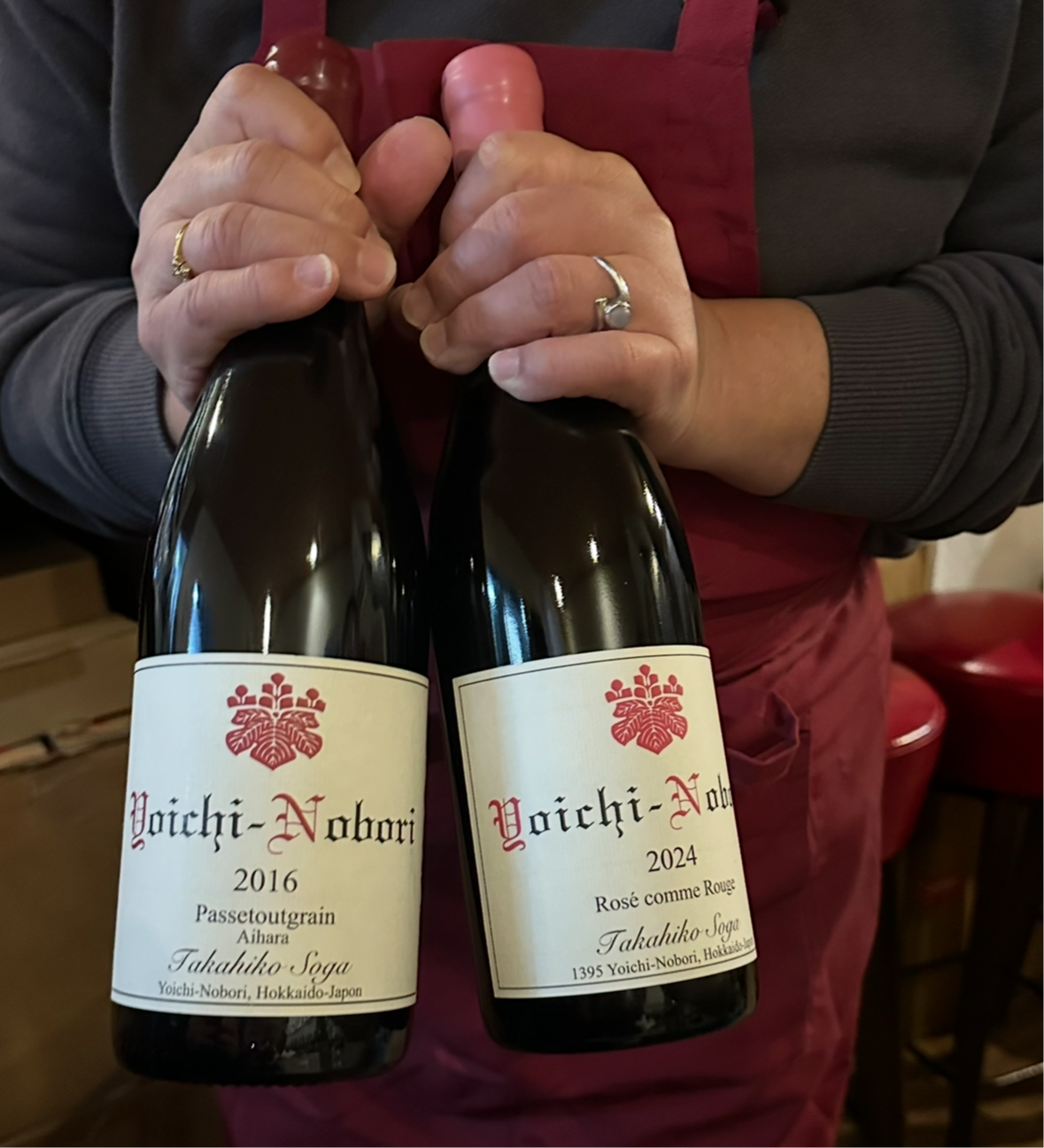
The most iconic producer in Japan is Takahiko.

If you’ve been following my Instagram stories, you know I’ve been trying to drink as much of his wine as possible. His wines are deeply respected, desperately sought-after, and nearly impossible to find, even within Japan. 

His tiny domaine sits in Yoichi, and everything he makes is rooted in place. Likely influenced by his years working in Burgundy and the Jura, Takahiko sees himself as a farmer first. His wines are true expressions of Yoichi’s cool, forested, maritime terroir.

He works with minimal intervention—wild fermentations, no additions, sulfur only if absolutely necessary—yet the wines are clean as the morning air. No volatile acidity, mousiness, or funk. Just savory, precise, understated powerhouses with a distinctly Japanese sense of umami and restraint.

We tasted the ’23 and ’24 Nana-Tsu-Mori Pinot Noir from his four-hectare vineyard planted on sandy volcanic soils. Though young, both were lifted and delicate, with forest floor, juniper, and tart cranberry notes. His 2016 Passetoutgrain (Pinot Noir and Zweigelt) was a lesson in cool climate aging potential… ten years old and still taut, energetic, and easily capable of evolving for another decade.

We also tried a tiny-production bottling called O-Lie—a playful blend of the bottoms of his barrels (both white and red). It sounds gnarly, but was surprisingly delicious, like a croissant paired with watermelon juice.

I’ve been hunting for a bottle to bring home, but every wine bar that pours Takahiko has just smiled and said: Impossible.

Another fascinating pour came from Domaine des Montilles (the iconic Burgundy house) which I had no idea had started a project in Hokkaido. They planted vineyards in 2016 (the first foreigners to do so in Japan) and released their first vintage in 2023. The Kerner we tasted was elegant and lip-smacking, like it came straight from Alto Adige: barely ripe white peach, jasmine, lemon sorbet. I’m excited to crack open the Chardonnay and Pinot Noir in my suitcase!


Where to Drink

Even in Sapporo, good wine at restaurants is rare. The standard throughout Japan remains sake, beer, and whiskey with meals. To drink well, you seek out wine bars.

Thanks to our friend Dennis, we found two standouts: Wine Bar Veraison and Natural Wine Bannachu.

Veraison is run by Sayuri (pictured above), who appears to be the godmother of Hokkaido wine. She’s had her shop for seventeen years, knows every producer personally, and has literally written the book on Hokkaido wine (though sadly there’s not yet an English translation). Her underground bar is filled with local gems you won’t find elsewhere.

Bannachu is a tiny speakeasy tucked up a staircase, serving only Hokkaido and Jura wines. (Talk about my happy place!). As tempted as you know I was by gorgeous Jura Savagnin, I stuck with Japan… Pinot Noir, Chardonnay, skin-contact Pinot Gris, and aged Hokkaido cheese that was a dead ringer for Manchego.


Though we only spent three days in Hokkaido, they have been some of the most memorable of the trip. The flavors were singular. The climate, too: eighteen degrees, snow nonstop. Sapporo is one of the snowiest cities in the world, yet completely prepared (heated sidewalks, warm buildings, snow plows operating constantly).

I’m now enjoying the “warm” forty degrees of Osaka. Even though I’m back home Wednesday, I’ll cover Kyoto and Osaka next week.

Kanpai,
Kelsey 🥂

Oh—and one more example of the fabulously thoughtful convenience of this country: luggage transfer. I bought fourteen bottles of wine in Hokkaido, packed them with bubble wrap and prayers, and instead of hauling them across Japan, sent them straight from my hotel in Sapporo to the Osaka airport—where they’re calmly waiting for me when I get to the airport to fly home. Talk about convenience. Are you taking notes, America?

Never Miss a Post

Join our newletter and stay up to date with all things wine related.